Why Big Platforms Fail Small Local Sellers – And How UniSub Empowers Neighbourhood Shops
Category: Guides
Why Big Platforms Fail Small Local Sellers – And How UniSub Empowers Neighbourhood Shops
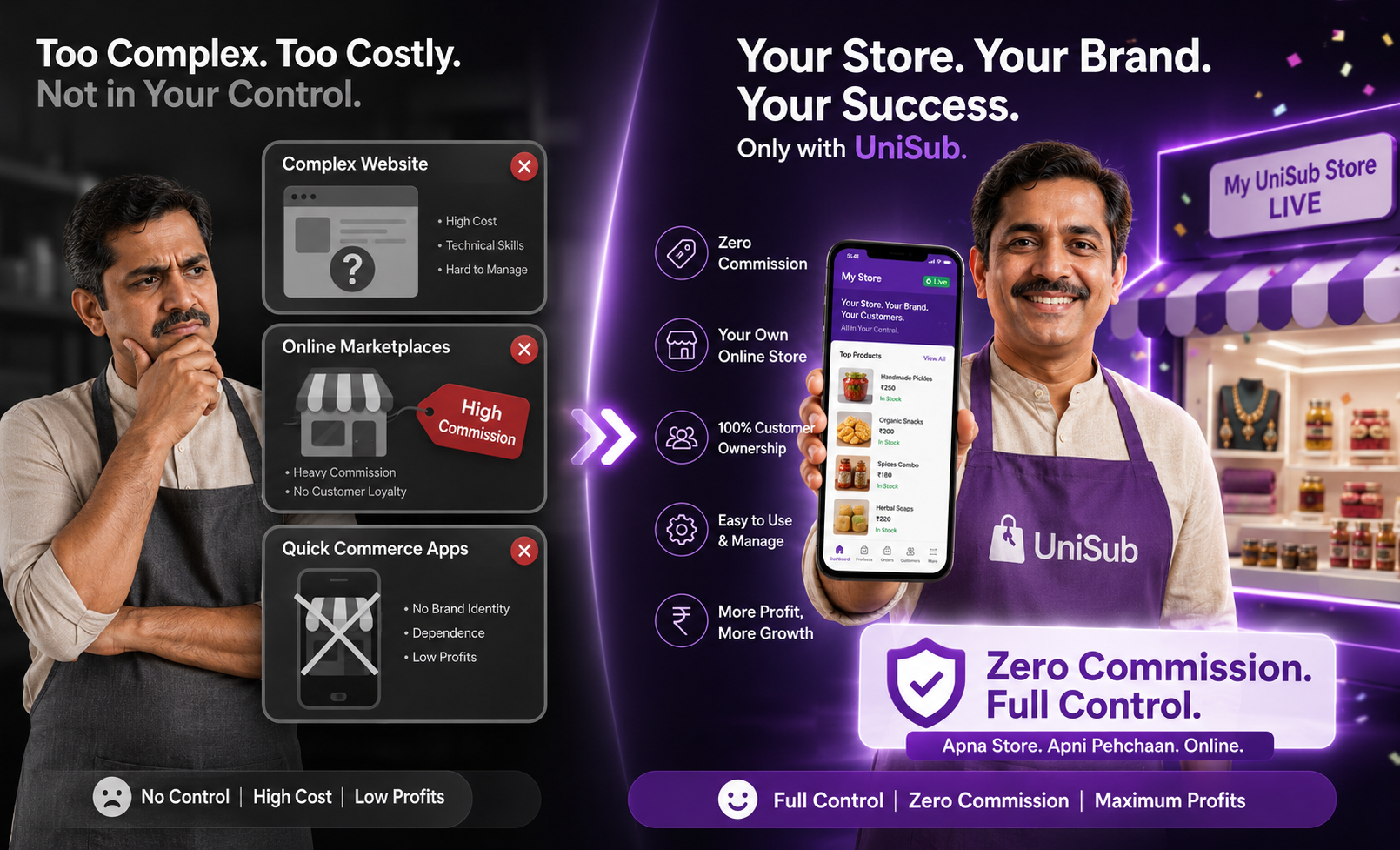
Running a shop today isn’t just about the customers who walk in. People search online before they buy — even from nearby shops. That’s why every seller is asking the same question: “How can I sell online without losing my identity or my profits?” The internet offers many ways: building your own website, joining large marketplaces, or listing on quick‑commerce apps. But the uncomfortable truth is that most of these options, despite sounding good, end up eating your money, time, and customer relationships. For a small shop in Shamli, a home‑based boutique in Noida, or a kirana store in Pune, the best platform for local sellers India isn’t the one with the biggest name — it’s the one that puts you in control. That platform is UniSub, a local subscription platform that gives you a free branded store, zero commission, direct payments, doorstep delivery, and subscription tools. Let’s see why the popular alternatives fail local sellers, and how UniSub is changing the game.
The Hard Truth About Popular Online Selling Routes
1. Building Your Own Website – A Showpiece, Not a Sales Engine
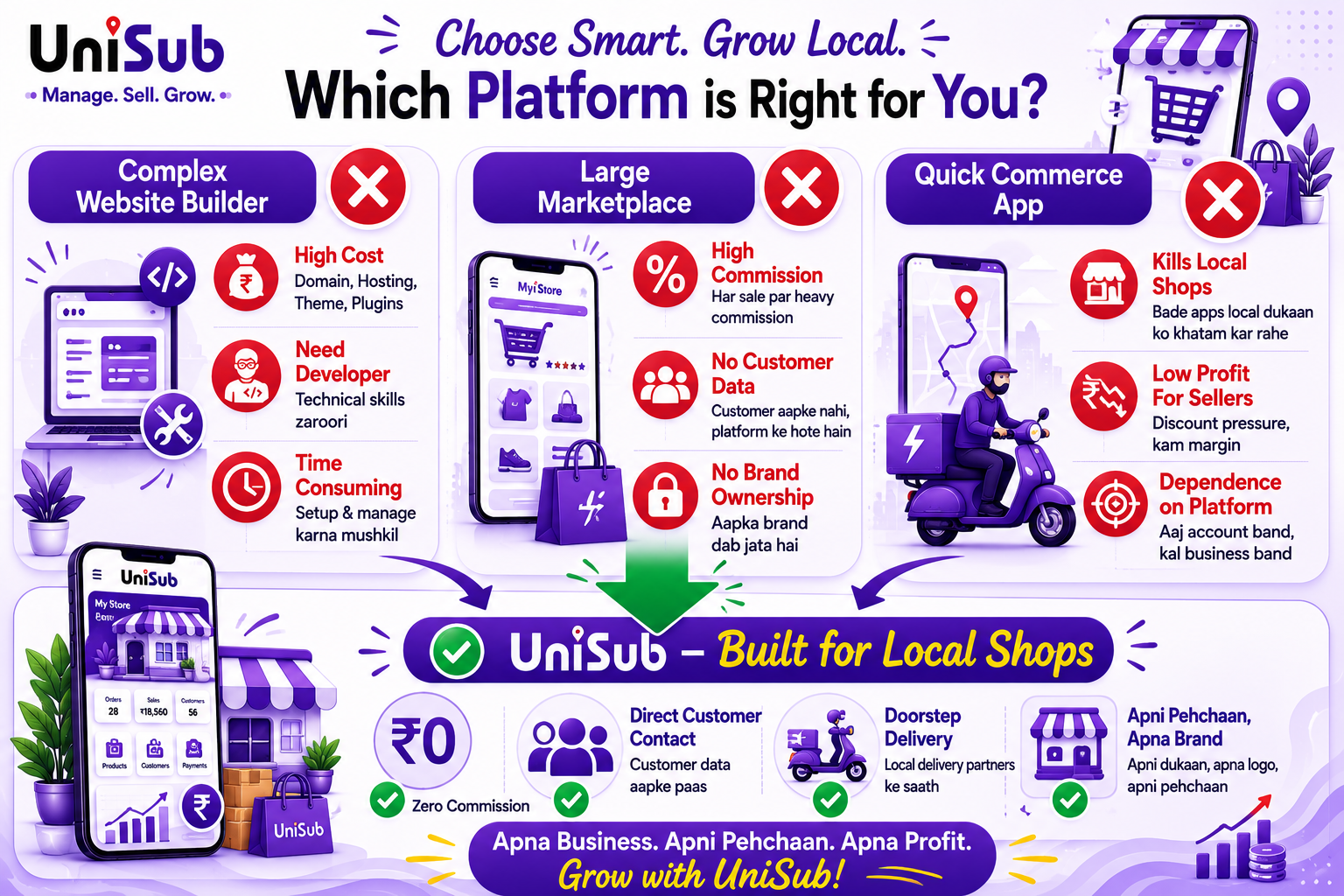
Having your own website sounds like the ultimate business move. Large businesses with deep pockets use websites to build global brands. But for a local shopkeeper selling pickles, jewellery, or pooja items, it’s a financial trap. A decent e‑commerce website costs anywhere from ₹30,000 to ₹2,00,000 to build. Then comes hosting (₹3,000–₹10,000 annually), security, updates, and the endless need for a developer to make even small changes. On top of that, you’re completely responsible for bringing traffic — which means heavy spending on ads and SEO, with agencies taking up to 30% of your ad budget as commission. The result? More cost, less sales, and a website that rarely pays for itself. It becomes a digital showpiece, not a growth engine.
2. Complex E‑commerce Store Builders – Too Heavy for Small Indian Shops
Some tools make it easier to build an online store compared to custom websites. They offer drag‑and‑drop features and nice themes. But they’re built for international brands and direct‑to‑consumer companies, not for a neighbourhood store. The pricing appears cheap initially, but soon annual costs can balloon to ₹30,000–₹1,50,000 when you add essential apps, payment gateways, and a developer to customise things. And they still don’t understand the Indian context: customers who want to talk before buying, who need Cash on Delivery, and who prefer ordering from a familiar local shop. These platforms are powerful, but too heavy and too expensive for the average Indian small seller.
3. Large Online Marketplaces – Profit Killers in Disguise
These platforms attract millions of buyers, and the traffic looks tempting. But they come with a steep price. Commissions can range from 20% to 30% per sale. You never get customer data — you don’t even know who bought from you. The return policies are designed by the marketplace, and you bear the loss. Your shop is just one among lakhs of identical listings. The customer remembers the marketplace, never your brand. You become a faceless supplier, completely dependent on the platform, while your margins shrink and your business never builds any loyalty. For a small seller who wants repeat customers and a real brand, this is a dead end.
4. Quick‑Commerce Delivery Apps – A Silent Threat to Local Shops
Quick‑commerce platforms deliver groceries and essentials in minutes, which customers love. But they operate through dark stores — small warehouses set up every few kilometres — that stock products directly. Earlier, some of these apps sourced from nearby local shops, but now they bypass them entirely. As these dark stores expand, walk‑in customers of local kirana stores decline. The convenience for the customer comes at the cost of the neighbourhood economy. Small shopkeepers lose direct connection with their community, and profit margins shrink as big players capture the daily needs market. It’s a silent, steady erosion of local commerce.
💡 The Common Thread: All these options take something vital away from you — your profit, your customer data, your brand identity, or your local connection. They were not designed with the Indian small shopkeeper in mind.UniSub – The Platform That Actually Works for Local Sellers
UniSub was built from the ground up for the Indian local business ecosystem. It’s a local subscription platform and digital marketplace that doesn’t fight against neighbourhood shops — it empowers them. When you create your store on UniSub, you get:
- Zero commission — 100% of every sale is yours. No hidden fees, no per‑order deductions.
- Your own branded store — your shop name, your logo, your identity. Customers remember you, not a platform logo.
- Full customer data — you receive phone numbers, order history, and the ability to build direct relationships. Send offers, ask for feedback, and create repeat buyers.
- Free, instant setup — launch your store in minutes from your smartphone. No coding, no developer needed.
- Built‑in doorstep delivery — deliver personally or use UniSub’s local delivery network to provide fast, reliable service.
- Subscription engine — create weekly or monthly product boxes (like “Daily Dairy & Bread” or “Festive Pooja Kit”) to lock in recurring, predictable income.
- You control your policies — set your own return and refund rules, not dictated by a third party.
- Local discovery — your store appears when people in your area search to buy from nearby stores online, making you the top choice for local shoppers.
With UniSub, you’re not just another seller ID lost in a sea of listings. You’re a trusted neighbourhood brand that thrives online — whether you’re in Shamli, Noida, Delhi, Gurugram, Pune, or anywhere in NCR. The platform aligns perfectly with the mission to support local businesses India and digitise local commerce without destroying it.
How UniSub Compares to What’s Out There
| Aspect | Complex Websites | Large Marketplaces | Quick‑Commerce Apps | UniSub |
|---|---|---|---|---|
| Commission | No per‑sale, but high fixed costs | 20–30% per sale | Procurement margins squeeze seller | Zero commission |
| Setup Cost & Time | ₹30k–₹2L, weeks, developer needed | Moderate, but complex paperwork | Not open for small shop listings | Free, 10 minutes, no coding |
| Customer Data | You own it, but costly | Hidden – you never get it | No direct relationship | Full – phone, order history |
| Brand Identity | Your brand, but expensive to build | Marketplace brand dominates | App brand dominates | Your shop name is the hero |
| Repeat Orders | Possible with marketing investment | Very low – no customer connect | No seller‑customer bond | Built‑in subscription engine |
| Impact on Local Economy | Neutral | Negative – kills local identity | Highly negative – replaces local shops | Positive – strengthens local commerce |
The Future Belongs to Platforms That Empower, Not Replace
India’s e‑commerce market is projected to grow massively over the next decade. But if local sellers rely only on platforms that prioritise their own brand, the neighbourhood shop — the backbone of our economy — will fade. The following trend illustrates what lies ahead if we don’t shift to seller‑first models:
| Platform Type | 2025 | 2030 | 2035 | Impact on Local Sellers |
|---|---|---|---|---|
| Quick‑Commerce Apps (Dark Stores) | Expanding rapidly in cities | Widespread network | Dominant in daily needs | Shrinks local grocery market drastically |
| Large Marketplaces | High seller volume, low brand control | Further consolidation | Sellers entirely dependent | Sellers lose brand and customer loyalty |
| UniSub – Local Seller Platform | 10K+ sellers, growing community | 1L+ sellers with hyperlocal reach | 10L+ sellers balancing online + offline | Protects and strengthens local markets, builds real brands |
UniSub is not just another selling platform — it’s a movement to digitise local commerce without erasing it. By giving small sellers their own branded online stores, direct customer access, and tools like subscription boxes and doorstep delivery, UniSub ensures that the local shop doesn’t just survive — it thrives.
Frequently Asked Questions
1. Why do large marketplaces fail small local sellers?
They charge high commissions (20–30%), hide customer data, and offer no branding. Your shop becomes just a listing, and you never build a loyal customer base. UniSub solves this with zero commission, full customer contact, and your shop name front and centre.
2. Is a custom website a good idea for my local shop?
For most local shops, a custom website is too expensive to build and maintain, and driving traffic requires a massive budget. UniSub gives you a ready‑to‑use, free store that’s optimised for local discovery — no developer needed.
3. How do quick‑commerce apps affect neighbourhood kirana stores?
Quick‑commerce apps set up dark stores and bypass local shops entirely, reducing walk‑in customers and shrinking the local market. UniSub, on the other hand, promotes your shop to nearby customers searching for “buy from nearby stores online,” strengthening your local presence.
4. Can I really keep 100% of my earnings on UniSub?
Absolutely. UniSub charges zero commission on every sale. The payment goes directly into your bank account with no deductions. You earn it, you keep it.
5. Do I need technical skills to set up my UniSub store?
Not at all. The platform is built for shopkeepers who aren’t tech‑savvy. You register with your mobile number, add your shop name, upload products, and you’re live — all in under 10 minutes.
6. How does UniSub help me get repeat customers?
You get full customer data, so you can message them directly on WhatsApp, offer personalised discounts, and build relationships. Plus, UniSub’s subscription engine lets you create recurring product boxes — turning one‑time buyers into lifelong subscribers.
7. Is UniSub only for grocery shops?
No. UniSub supports all categories — clothes, jewellery, handmade crafts, pooja samagri, bakery items, electronics, beauty products, and more. Any product a local shop sells can be listed.
Don’t Let Big Platforms Own Your Business. Start Your Free UniSub Store Today.
Thousands of local sellers have already found the best platform for local sellers India — UniSub. Create your branded online store now, keep 100% of your profit, and bring your neighbourhood shop to every doorstep.
Create Your Free UniSub StoreYour shop, your identity, your growth. No commissions. No compromises.